
Staff Cafés and Canteens in Turkey's Industrial Zones: Shifts, Menus and Operating Models
Staff cafés and canteens in Turkish industrial zones: shift-based menus, kitchen flow, in-house vs catering, 2026 cost figures and the legal requirements.
In a factory, lunch is measured in minutes, not hours. When the shift bell rings, hundreds of people pick up a tray at the same moment. If the line jams for ten minutes, people either leave half their meal or get back to the machine late. That's why setting up a café, canteen or staff restaurant in one of Turkey's organised industrial zones (OSBs) or on a factory campus is nothing like opening a café in town. The guests are the same every day, the times are fixed, and nobody has time to wait.
This guide is for plant managers, HR and facilities managers who are thinking about opening an in-house café, cafeteria or staff canteen in an OSB or a factory, or upgrading the one they have. I go through the choice of format, the menu, the kitchen layout, the difference between running it yourself and handing it to a catering contractor, the cost lines and the legal requirements, in that order. Regulations and figures come from official and current Turkish sources accessed on 18 October 2026; they're listed at the end.
First decision: canteen, café, or both?
In an OSB, "food" can mean three different businesses, and mixing them up is the most expensive mistake.
- Staff canteen (set menu, "tabldot"): the employer pays for the meal; staff pay nothing or a token contribution. The goals are speed, a filling plate and consistent quality.
- Café-restaurant or cafeteria: staff, visitors and neighbouring companies pay out of their own pocket. It sells coffee, breakfast, a light lunch and grab-and-go items, so revenue and margin start to matter.
- Hybrid: a set-menu line at lunch and a café for the rest of the day. One kitchen and one team carry both jobs. Set up well, this is the most efficient model; set up badly, it does both jobs halfway.
Before deciding, write down answers to three questions: how many people eat each day, and on which shifts? Who pays for the meal? Will the space also be open to outsiders, such as visitors and neighbouring firms?
Shifts set the rhythm
A café in town waits for its guests; a factory café knows exactly when they'll arrive. That's a big advantage when you plan.
Break the lunch peak down into minutes
How long is the meal break, how many people come out at once, and how long is the walk from the tray point to a seat? Work the line capacity backwards from those three numbers. Staggering breaks by department, 15 minutes apart, is usually far cheaper than building a second service line.
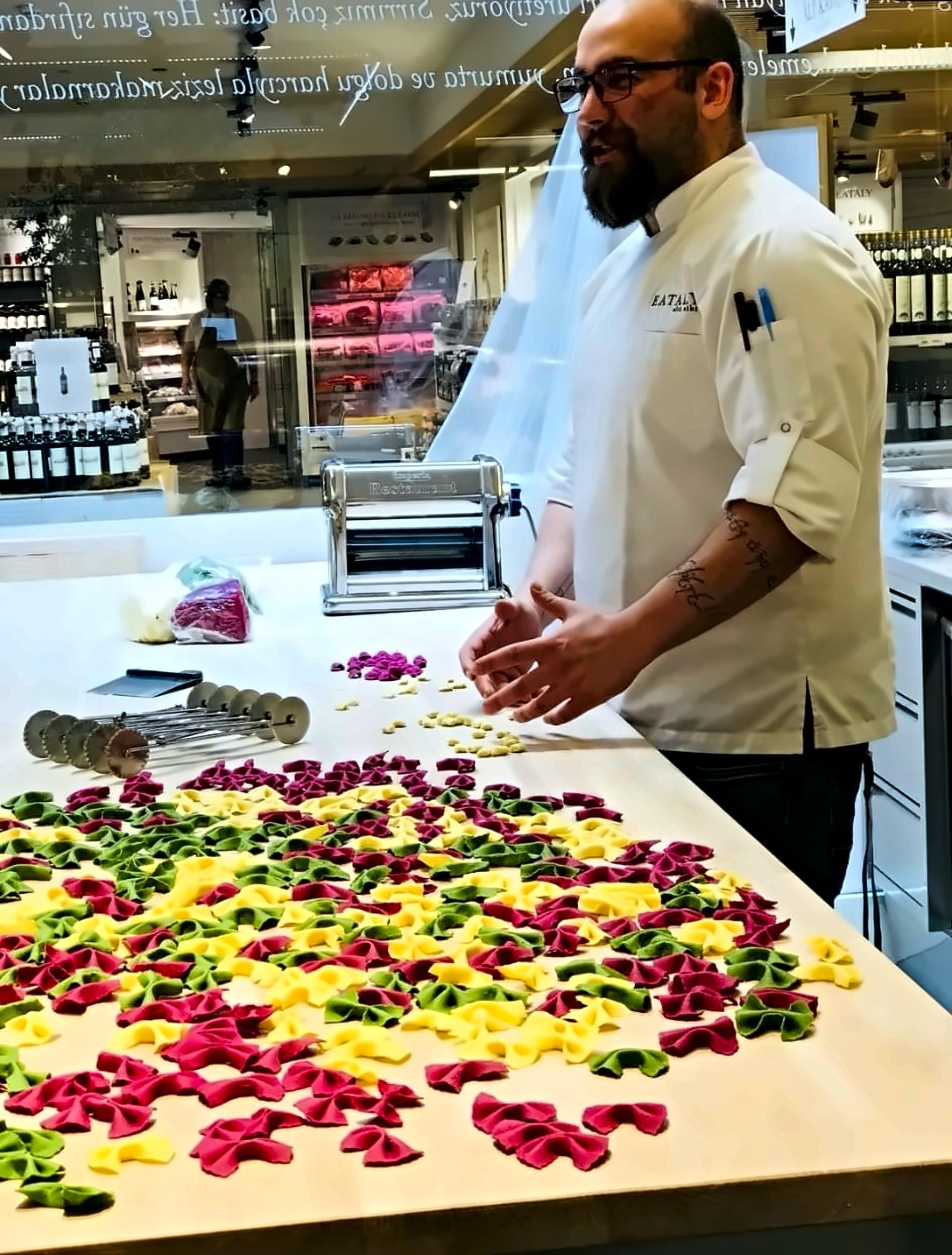
A note from Chef Tuluğhan: The best way to get through a busy service without trouble is solid prep, clear roles and complete, clean equipment: plates, pans, serving spoons. With order tickets, the biggest mistake is reading every ticket one by one; in a rush, nobody can follow past the third ticket. So I group orders: I gather as many as I can send out at the same time, then call them together. The team reacts as if I were reading a single ticket, and the dishes come up fast. The system is what brings success.
Don't forget the night and early shifts
In a plant running three shifts, the night team often eats the worst food on site: lunch leftovers, reheated. Give the night shift its own short menu. Items prepared in advance, held in the cold chain and finished at the moment of service are safe, and they work without a full kitchen brigade on nights. At shift change, tea, coffee and quick breakfast items are the café's most reliable sales.
Menu planning: short, rotating, shared prep
In a corporate kitchen, the menu's job is to put out the same quality at the same speed every single day.
- Use a menu cycle. A four- or six-week cycle makes purchasing easier and helps the team learn. Swap two or three dishes at the end of each cycle based on staff feedback.
- Share the prep. Roasted vegetables from the lunch line go into café sandwiches in the afternoon; the breakfast cheese ends up on the lunch salad bar. Every ingredient should have at least two uses.
- Choose dishes for the line. Food that goes onto the plate in one movement (stews, oven dishes, rice, salads) is fast. Cooked-to-order items belong in the café, and in small numbers.
- Write a standard recipe card for every dish: weights, portion size, cost and a plating photo. The card is the only guarantee that a team of average skill puts out the same plate every day.
- Plan for allergens and special diets from the start. A vegetarian option, a gluten-free alternative and an allergen chart are standard in a large workplace, not extras.
- Think about people doing heavy work. Someone on a production line may need a different meal from someone in the office. Adjust portions and sides such as bread and soup accordingly.
Kitchen and space: flow is everything
Your architect or kitchen contractor decides the size of the dining hall and where the kitchen goes. On the kitchen side, the real question is flow: deliveries → cold and dry stores → prep → cooking → portioning → service → dishwash → waste. Clean and dirty routes mustn't cross, and returning dirty trays shouldn't pass in front of the people still queuing.
Choose equipment after the menu. Take the busiest day of your menu cycle and work out the pots, ovens and bain-marie capacity that day needs. I explain how the equipment list follows from the menu in What It Costs to Open a Restaurant in Turkey in 2026.
The legal floor is clear too. Turkey's regulation on health and safety in workplace buildings requires employers to give staff who eat at work an eating area that's comfortable and large enough, with suitable temperature and hygiene and enough equipment. The employer may also provide meals off site, as long as the place meets the same conditions.
Operating model: your own team or a catering contractor?
This decision shapes both the budget and the quality. There's no single right answer: it depends on the size of the site and how much the company wants to manage.
| Run it yourself | Contractor, cooked on site | Delivered meals | |
|---|---|---|---|
| Control of menu and quality | Fully yours | Depends on the contract and spec | Limited |
| Staff and social-security burden | Yours | The contractor's | The contractor's |
| Investment | Kitchen and equipment are yours | Often shared | Lowest |
| Flexibility (café, events, nights) | High | Medium | Low |
| Risk | Team and purchasing sit with you | Depends on choosing the right firm | Hot-holding time and transport |
With delivered meals ("taşıma yemek"), food is cooked in a central kitchen and arrives in insulated boxes. The investment is low, but the plate is served hours after it was cooked. Cooking on site is fresher and more flexible, but you need a kitchen and a team on site.
If you go with a contractor, put it in the specification
- The menu cycle, portion weights and product specifications (brand or quality grade)
- Shift times, night service and breakfast
- Hygiene records, sample retention and your right to inspect
- Staff numbers, training and hygiene certificates
- How satisfaction is measured, and what happens when quality drops
Anything that isn't in the spec is the first thing to go in the first price negotiation.
Costs: which lines, which figures?
A staff canteen's cost has four main lines: food, staff, energy and consumables, and rent or depreciation. A firm number only comes from your headcount, your menu and your shifts, but a few current figures are enough to start the calculation.
- Staff: according to Turkey's Ministry of Labour, the gross minimum wage in 2026 is TL 33,030 a month. The total cost to the employer is TL 39,223.13 in manufacturing, with the 5-point social-security discount, and TL 40,214.03 in other sectors, with the 2-point discount. If you run the canteen yourself, size the team together with the number of shifts.
- Catering prices: a catering marketplace's 2026 factory-meals page gives "market averages" of TL 75–105 per person for a standard three-dish set menu and TL 160–220 for an open-buffet subscription, and names 200 people as a typical minimum. These are averages from a marketing page, not quotes; they only give you an order of magnitude.
- Tax and social security: according to the Revenue Administration's 2026 guide to employment income, meals provided to staff at the workplace or its annexes are exempt from income tax with no cap. Where no meal is served on site (meal cards, vouchers and the like), the exemption covers up to TL 300 a day in 2026. Since 17 April 2026 social security follows the same split: after an amendment to the Social Insurance Regulation, meals served at the workplace are fully excluded from the contribution base, while meals provided elsewhere are excluded up to TL 300 a day. Factor this difference into the build-or-not decision with your accountant.
Hygiene and legal requirements
- Business Registration Certificate (İşletme Kayıt Belgesi): as a mass-catering site you need to register under Law No. 5996; you can apply through e-Devlet. If a contractor runs the kitchen, make it clear in the contract whose name the registration is in.
- Workplace Opening and Operating Licence: under Article 4 of the Organised Industrial Zones Law No. 4562, building permits and workplace licences inside an OSB are issued and inspected by the OSB itself, not the municipality. Talk to the OSB management before any kitchen or dining-hall works start.
- Hygiene training: everyone who handles food directly needs hygiene training from an institution affiliated with the Ministry of Education (Ministry of Health).
- Sample retention: under the Ministry of Agriculture and Forestry's official sampling procedure, businesses serving food for mass consumption must keep a sample of every item from every batch for 72 hours, chilled or frozen; the recommended amount is 250 grams. If food poisoning is ever suspected, those samples are your most important record.
- HACCP-based records: goods-in checks, fridge temperature logs, cooking and hot-holding temperatures, a cleaning schedule and an allergen chart. ISO 22000 certification is voluntary, but keeping your records with that discipline from day one makes both inspections and catering tenders easier.
- Occupational health and safety: the temperature, hygiene and equipment of the eating area fall under the regulation mentioned above. Include the kitchen team's risk assessment in your site's health and safety plan.
Where a consulting chef helps
The architect brings the dining hall, the kitchen contractor brings the kitchen, the caterer brings the plate. The gap in between is usually this: will this menu really come off this line, with this team, in these minutes? My job is to answer that before opening:
- Discovery: headcount, shifts, break lengths, budget and the state of the existing space.
- Format and operating model: canteen, café or hybrid; in-house or contractor. If you choose a contractor, the technical specification.
- Menu and recipes: a menu cycle, standard recipe cards, portions and costing.
- Kitchen flow and equipment list: together with the architect and the kitchen contractor, a list derived from the menu.
- Hygiene file and training: HACCP-based record forms, pre-opening team training and trial services.
- Opening and beyond: line times, waste and satisfaction measured in the first weeks, and a menu review at the end of the first cycle.
A note from Chef Tuluğhan: I joined a new project in Bursa: a fast opening with no team in place yet. Because time was short, I had to start not with a fully qualified team but with whoever I could find, and the people who joined had very little in common. Once the team was complete, I spent a few days observing everyone: their attitude, and what their hands were naturally good at. Then I placed each person at a station and built the menu around that team. Within about one to two weeks, everyone had the basics down. The opening went really well, and by our third week this team of complete opposites was playing as one and serving everything to standard. Apart from supplier surprises, the team had found its rhythm and kept moving forward.
For the café side, I've collected everything to check before opening in Opening a Café in Turkey: A 40-Point Pre-Opening Checklist. If you're considering a hybrid model, that list will help too.
FAQ
What permits do I need to open a café or canteen in an OSB?
A Business Registration Certificate as a mass-catering site (Provincial Directorate of Agriculture and Forestry), hygiene training certificates for everyone who handles food, and a Workplace Opening and Operating Licence. Inside an OSB, that licence is issued by the OSB management under Law No. 4562, not by the municipality, so ask your OSB which documents it requires before you apply.
Should we run our own canteen or hire a catering contractor?
If you want to keep control of the menu and quality and add extras such as a café or events, run it yourself or use a contractor that cooks on site. If you want the lowest investment and staff burden, delivered meals. On smaller sites, check the contractors' minimum headcount too.
Are meals served at work subject to income tax and social security?
According to the Revenue Administration's 2026 guide, meals served at the workplace or its annexes are exempt from income tax with no cap. Since 17 April 2026, they're also fully excluded from the social-security contribution base; with meal cards, the exemption is up to TL 300 a day. Confirm your own situation with your accountant.
How long must food samples be kept?
Under the Ministry of Agriculture and Forestry's official sampling procedure, a sample of every item from every batch must be kept for 72 hours, chilled or frozen; the recommended amount is 250 grams.
When should a consultant get involved?
Before the floor plan is final. Menu changes made after the kitchen's position and flow are drawn usually mean building work or new equipment.
Let's go through your project together
Every site has different shifts, headcounts and budgets. If you send me a short note with your headcount, shift times and the state of the space for the café or canteen you want to open or upgrade, we can set up a first call through the contact page. I usually reply within 48 hours.
Sources (accessed 18 October 2026): Official Gazette, Regulation on Health and Safety Measures in Workplace Buildings and Annexes (17.07.2013), Annex 1 item 48 · Ministry of Labour, Minimum Wage 2026 · YMK Catering, Factory meals 2026 · Revenue Administration (GİB), 2026 employment income guide · Official Gazette, amendment to the Social Insurance Regulation (18.04.2026) · Ministry of Agriculture and Forestry, Official Sampling Procedure · Organised Industrial Zones Law No. 4562 · e-Devlet, Business Registration Certificate · Ministry of Health, Hygiene training